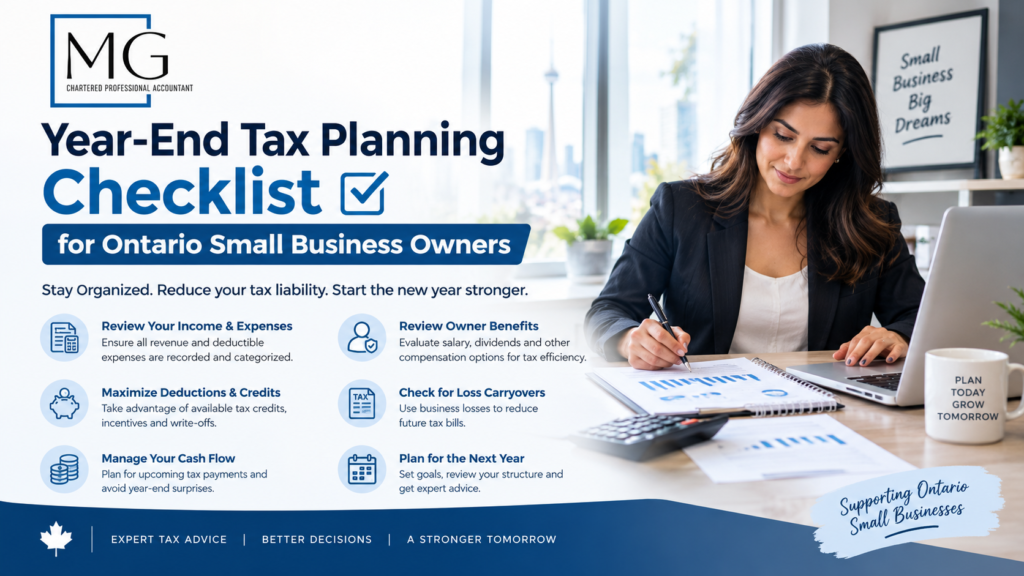
Most tax savings for a small business are decided before the year ends, not when the return is filed. Once your fiscal year closes, you can report what happened, but you can rarely change it. That makes the last two months before your year-end the most useful time to review your numbers.
The short answer: before your year-end, check your profit position, decide how and when to pay yourself, review timing of purchases and expenses, confirm your RRSP and instalment position, and make sure your books are current. The checklist below walks through each step for the 2026 tax year.
This article is general information for Ontario business owners. Your situation may differ, so confirm decisions with your accountant.
Step 1: Know your year-end and your numbers
Start with two questions:
- When does your fiscal year end? Sole proprietors usually use 31 December. Corporations can have a different year-end, so “year-end planning” may fall in another month for you.
- What will your profit be? You can’t plan without up-to-date books. Bring your bookkeeping current to at least the end of October or November, and estimate the rest of the year.
If your books are behind, start there. See our guide to catch-up bookkeeping before year-end and our bookkeeping services.
Step 2: Review the small business deduction position (corporations)
Canadian-controlled private corporations (CCPCs) may claim the small business deduction on active business income up to the business limit. According to the CRA, the federal small business rate is 9% and the business limit is $500,000; Ontario’s lower rate is 3.2%, also on a $500,000 limit.
Two things can reduce the business limit:
- Associated corporations, which generally share one business limit.
- Passive investment income. The CRA explains that the business limit is reduced when the corporation (and associated corporations) earn adjusted aggregate investment income above $50,000, and is eliminated at $150,000.
If your corporation holds investments, review the expected investment income before year-end.
Step 3: Decide how to pay yourself
Owner-managers usually take money out of a corporation as salary, dividends or a combination. Each choice affects:
- Personal tax in 2026
- CPP contributions and future CPP benefits
- RRSP contribution room for future years
- The corporation’s deductions
We explain the trade-offs in Salary vs Dividends in Ontario. Make the decision before year-end, because salary must be run through payroll, with source deductions remitted, to count.
Family members: paying dividends to family members can trigger the tax on split income (TOSI) unless an exception applies. Get advice before paying dividends to anyone other than the active owner.
Step 4: Consider bonuses and unpaid salaries
A corporation can sometimes accrue a bonus at year-end and pay it after. Under the Income Tax Act, unpaid remuneration is generally deductible only if it is paid within 180 days after the end of the tax year. If it isn’t, the deduction is deferred to the year it is paid. Confirm timing and payroll remittances with your accountant before relying on an accrued bonus.
Step 5: Time your expenses and purchases
- Expenses you’ll incur anyway: paying deductible expenses before year-end brings the deduction into this year. Don’t spend money you wouldn’t otherwise spend just to save tax.
- Equipment and other capital purchases: capital assets are usually deducted over time through capital cost allowance (CCA), not all at once. The year an asset becomes “available for use” affects the claim, so check timing with your accountant before buying.
- Inventory: plan your year-end count.
Step 6: Check your RRSP room (individuals)
Salary and self-employment income create RRSP room for the following year. The CRA’s RRSP dollar limit for 2026 is $33,810. Your personal limit depends on your earned income and is shown on your notice of assessment.
Contributions made in the first 60 days of 2027 can generally be deducted on your 2026 return. Confirm the exact 2027 deadline on the CRA website. Our guide to RRSP vs TFSA vs FHSA explains how the three accounts compare.
Step 7: Review instalments
If you pay personal tax instalments, the CRA’s 2026 instalment dates for individuals are 15 March, 15 June, 15 September and 15 December. Corporations pay monthly or quarterly depending on their situation. If your 2026 income is higher than expected, review whether your instalments are still enough. See Tax Instalments in Canada.
Step 8: Tidy up shareholder and related-party balances
Review the shareholder loan account. Amounts you borrowed from the corporation, or personal expenses paid by the business, can have tax consequences if they aren’t dealt with within set time limits. Ask your accountant to review the balance before year-end.
Step 9: Prepare for payroll and GST/HST year-end
- Payroll: T4 slips for 2026 are due by the last day of February 2027. Make sure employee and owner salaries are recorded correctly. See our payroll services.
- GST/HST: reconcile collected tax and input tax credits before year-end. See our HST/GST filing page.
Step 10: Plan your filing deadlines
| Filing | General rule (confirm for your situation) |
| Corporation T2 return | Within six months after the tax year-end |
| Corporation balance owing | Generally two months after year-end; three months for some CCPCs that meet CRA conditions |
| Self-employed individual T1 | Filing by 15 June 2027 for the 2026 tax year; balance owing by 30 April 2027 |
| T4 slips | By the last day of February 2027 |
See T2 Corporate Tax Return: Deadlines and What to Prepare.
Year-end checklist
| Task | Done |
| Confirm fiscal year-end date | ☐ |
| Bring bookkeeping up to date | ☐ |
| Estimate 2026 profit | ☐ |
| Review small business deduction and passive income | ☐ |
| Decide salary, dividends or both | ☐ |
| Check TOSI before paying family members | ☐ |
| Plan any bonus within the 180-day rule | ☐ |
| Review timing of expenses and capital purchases | ☐ |
| Check RRSP room and contribution plans | ☐ |
| Review instalments (15 December for individuals) | ☐ |
| Review shareholder loan balance | ☐ |
| Prepare payroll and GST/HST year-end | ☐ |
Frequently asked questions
When should I start year-end tax planning?
Two to three months before your fiscal year-end. That gives time to update your books and act before the year closes.
Can I reduce my corporation’s tax after year-end?
Some choices, such as how much CCA to claim, are made when the return is filed. Most decisions about income, pay and spending must be made before year-end.
Is a salary or dividend better for 2026?
It depends on your income, RRSP and CPP goals, and the corporation’s position. See our salary vs dividends guide, and get a calculation for your numbers.
Do sole proprietors need year-end planning?
Yes. Timing expenses, RRSP contributions, instalments and GST/HST all matter for self-employed individuals.
Is this checklist personal tax advice?
No. It is general information. Speak with a CPA about your specific situation.
Plan your year-end with CPAMG
CPAMG works with owner-managers in Etobicoke, Toronto and across the GTA on year-end planning, corporate tax and bookkeeping. Book a consultation before your year-end, or learn more about our tax planning services.
This article provides general information for the 2026 tax year, verified 11 October 2026. Tax rules change and depend on individual circumstances. It is not tax, legal or financial advice.